How Do You Convert Square Feet to Linear Feet? (The Right Way)
Converting square feet to linear feet trips up even experienced builders — not because the math is hard, but because one wrong assumption ruins the entire order.
You’ve measured your room. You know the square footage. But the lumber yard wants linear feet, and suddenly the project stalls. Here’s exactly how to make that conversion — and avoid ordering the wrong amount.
Job Parameters
Enter the square footage and board width to get the required linear footage.
The Core Formula
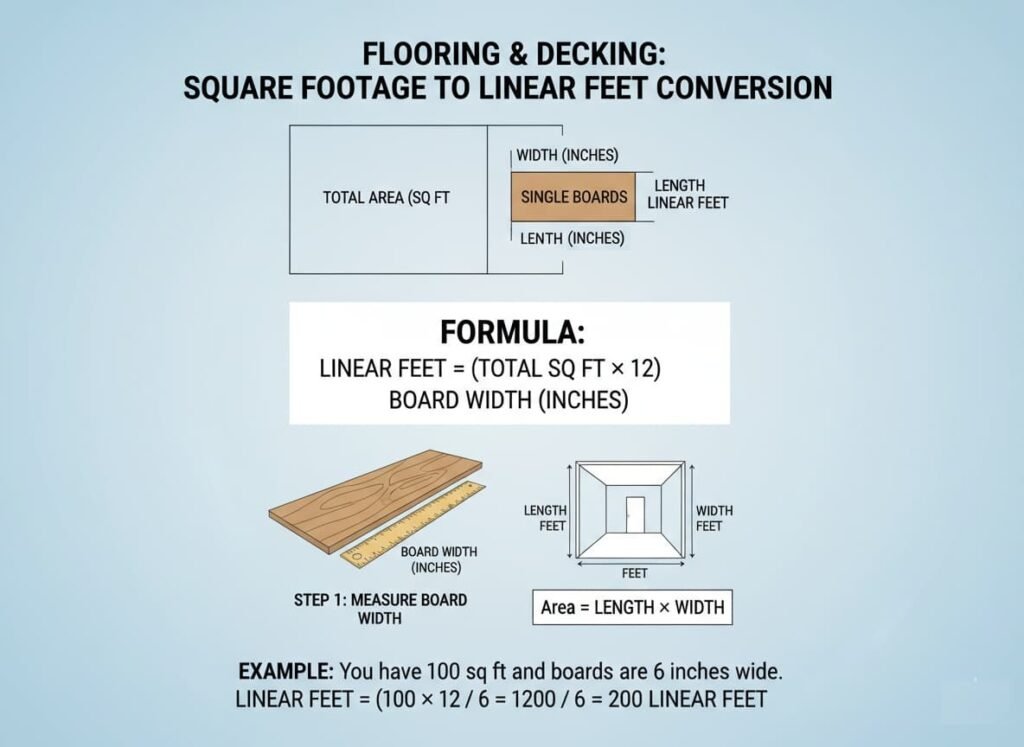
The conversion isn’t direct. Square feet measure area. Linear feet measure length. To connect them, you need one more piece of information: the width of your material.
Formula A — Width in Feet:
Linear Feet = Square Feet ÷ Width (ft)
Formula B — Width in Inches:
Linear Feet = (Square Feet × 12) ÷ Width (in)
Both formulas give the same result. Use whichever matches how your material is labeled.
Step-by-Step: How to Convert Square Feet to Linear Feet
- Measure your total area in square feet (length × width of the space)
- Find your material’s width — check the product label or spec sheet
- Convert width to feet if it’s listed in inches (divide by 12)
- Divide square footage by the width in feet
- Add 10–15% for waste — cuts, mistakes, and offcuts always cost you material
That’s the entire process. The formula never changes. What changes is the width — and that’s where most people go wrong.
Real Examples by Material
Hardwood Flooring
Scenario: 200 sq ft room, 3.25-inch wide planks
Width in feet = 3.25 ÷ 12 = 0.271 ft Linear Feet = 200 ÷ 0.271 = 738 LF With 10% waste: ~812 LF
Deck Boards
Scenario: 150 sq ft deck, 5.5-inch wide boards
Width in feet = 5.5 ÷ 12 = 0.458 ft Linear Feet = 150 ÷ 0.458 = 327 LF With 15% waste: ~376 LF
Exterior Siding / Shiplap
Scenario: 300 sq ft wall, 6-inch shiplap with ½-inch reveal
Use exposed face width = 5.5 inches = 0.458 ft Linear Feet = 300 ÷ 0.458 = 655 LF With 10% waste: ~721 LF
The Detail Most Guides Skip: Exposed Face Width
This is the single most common ordering mistake.
When you install shiplap, tongue-and-groove, or lap siding, boards overlap. The total board width is, say, 6 inches — but only 5.5 inches of that is visible after installation.
Always use the exposed face width, not the total board width, in your formula. Using the wrong number means ordering short every time.
| Material | Listed Width | Exposed Width to Use |
|---|---|---|
| 1×6 Shiplap | 5.5 in | 5.0 in (with ½” reveal) |
| Tongue & Groove | 3.5 in | 3.0 in |
| Lap Siding | 6.0 in | 5.25 in |
| Standard Decking | 5.5 in | 5.5 in (full exposure) |
How Do You Convert Square Feet to Linear Feet for Specific Projects?
Baseboards
Baseboards don’t use square footage at all — they follow the perimeter, not the floor area. Measure the total length of all walls in the room. That number is already in linear feet.
A 12×12 room has a perimeter of 48 linear feet (minus doorways). Square footage is irrelevant here.
Fencing
Fence pickets are ordered in linear feet based on the total run of fence, not the area of your yard. Use the perimeter of the fenced section as your starting point, then calculate picket count based on spacing.
Flooring in an Irregular Room
Break the room into rectangles. Calculate square footage for each section separately, then add them together before running the formula. One total square footage number into one conversion keeps the math clean.
How to Convert Linear Feet Back to Square Feet
Sometimes you already have the boards — and need to know how much area they’ll cover. The reverse formula is just as simple:
Square Feet = Linear Feet × Width (ft)
Example: 500 LF of 6-inch boards
500 × 0.5 = 250 sq ft
Useful when you’re working with leftover stock or estimating coverage before purchasing additional material.
Always Add the Waste Factor
A 10% waste factor is the minimum for straightforward projects. Go to 15% when you have:
- Diagonal installations (flooring laid at 45°)
- Lots of cuts around doorways, corners, or irregular shapes
- Reclaimed or natural wood with higher defect rates
- Pattern matching requirements (herringbone, chevron)
Running short on material mid-project is far more expensive than buying an extra board upfront. Return policies exist for a reason — over-ordering is always the safer call.
Use a Free Calculator to Skip the Math
If you’re working with multiple rooms or unusual widths, doing this by hand gets tedious fast. A dedicated free square feet to linear feet calculator handles the formula instantly and lets you toggle waste percentages in real time.
It supports both inch and foot input for board width, includes common standard board sizes, and adds the overage factor automatically — so your final number is already project-ready.
Frequently Asked Questions
How many linear feet is 100 square feet? It depends entirely on material width. With 6-inch boards, 100 sq ft = 200 LF. With 3-inch boards, 100 sq ft = 400 LF. There’s no single answer without knowing the width.
How many linear feet is 160 square feet? With 4-inch boards: 160 ÷ 0.333 = 480 LF. With 6-inch boards: 160 ÷ 0.5 = 320 LF. Always confirm your board width first.
How many linear feet is 1,000 sq ft? With 4-inch boards: 1,000 ÷ 0.333 = 3,003 LF. With 6-inch boards: 1,000 ÷ 0.5 = 2,000 LF. Wider boards mean fewer linear feet required.
Can you convert square feet to linear feet without knowing the width? No. Width is a required input. Without it, you’re converting area to length — two measurements that don’t share a direct relationship.
How many linear feet are in a 12×12 room? The room is 144 square feet. To find linear feet for flooring, divide 144 by the width of your planks in feet. For a 4-inch board: 144 ÷ 0.333 = 432 LF. For baseboards, just measure the perimeter: 48 LF.
How many linear feet is 400 sq ft? With 4-inch wide material: 400 ÷ 0.333 = 1,200 LF. With 6-inch material: 400 ÷ 0.5 = 800 LF. Width determines everything.
The formula is simple — the judgment call is knowing which width to use and how much buffer to build in. Get those two things right, and your material order lands exactly where it needs to.
Measure accurately, order confidently, and build without surprises.